Social Media Marketing for Clinics: What Actually Brings Patients (Not Just Likes)
Updated: Apr 17

Social media marketing for clinics works when it builds trust before asking for anything. Patients do not book appointments because they saw a pretty Instagram post. They book because they saw enough of your clinic's content over the weeks to feel safe picking up the phone.
That distinction matters. Most clinic owners we talk to have tried social media at some point. They posted for a few weeks, got a handful of likes from friends and staff, and stopped because no patients came from it. The problem was never the platform. The problem was treating social media like a billboard instead of a conversation.
The clinics that actually get patients from social media, whether they offer TMS therapy, neurofeedback, or naturopathic care, follow a specific pattern. They educate first, show their face second, and ask for the booking third. Skip any step and the whole thing falls flat.
Why Do Most Clinics Fail at Social Media?
The most common mistake is jumping straight to promotion. A clinic opens an Instagram account, posts "Now accepting new patients" with a stock photo, and waits. Nothing happens. Then they conclude that social media does not work for healthcare.
But think about it from the patient's side. Someone dealing with treatment-resistant depression or chronic anxiety is not scrolling Instagram looking for a clinic to call. They are looking for answers. They want to know if their symptoms are normal, what treatment options exist, and whether other people have gone through what they are going through.
When your content answers those questions instead of selling, something shifts. Patients start following. They read your posts for a few weeks. They share one with a family member. And when they are ready to take the next step, your clinic is the one they trust.
The 3 mistakes that waste the most time
Posting about your clinic instead of posting about your patients' problems. Nobody cares about your new office chairs. They care about whether neurofeedback can help their child focus better at school.
Inconsistency. Posting 5 times one week, then disappearing for a month. Patients notice. It signals unreliability, and unreliable is the last thing a healthcare provider wants to look like.
Chasing likes instead of trust. A meme might get 200 likes. A 60-second video of your doctor explaining what happens during a TMS session might get 40 likes but 3 booked consultations. The second one is worth more.
Start building trust with your audience before asking them to book. Call us!
What Does a Trust-First Social Media Strategy Look Like?
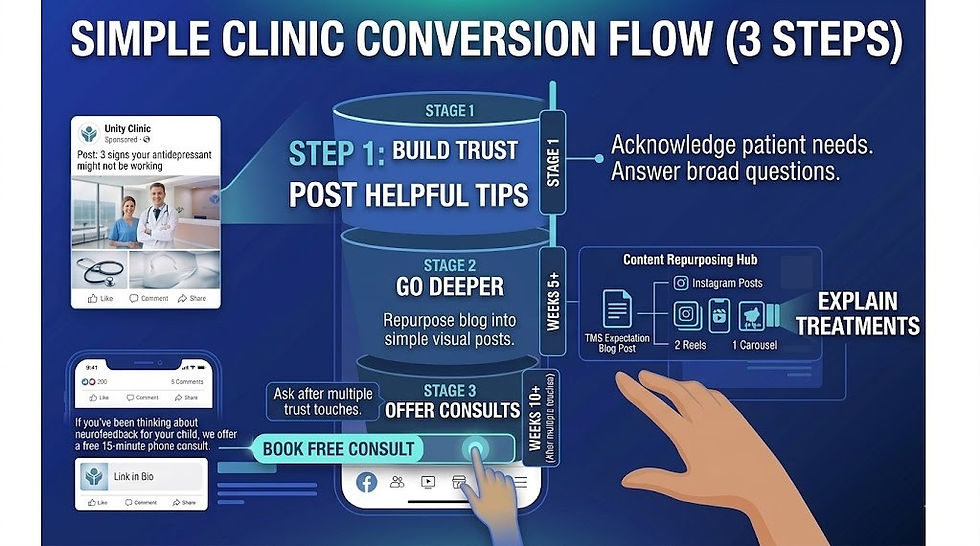
A trust-first strategy follows three stages: awareness, education, and conversion. Most clinics skip straight to conversion. That is like proposing marriage on the first date.
Stage 1: Awareness
At this stage, potential patients do not know your clinic exists. They might not even know that treatments like TMS or neurofeedback are options for them. Your content here should answer broad questions without mentioning your clinic at all.
Posts like "3 signs your antidepressant might not be working" or "What is neurofeedback and who is it for?" work well here. You are not selling anything. You are showing up in someone's feed with information they genuinely need.
Stage 2: Education
Once someone follows you, the next step is going deeper. Explain how specific treatments work. Show what a first appointment looks like. Address the fears patients have but never say out loud: "Will it hurt?" "Will my insurance cover it?" "How long before I feel different?"
This stage is where content marketing for healthcare and social media overlap. A blog post on your website about what to expect during TMS therapy can be broken into 5 Instagram posts, 2 reels, and a carousel. One piece of content, repurposed across channels.
Stage 3: Conversion
Only after someone has seen your content multiple times should you ask them to take action. And even then, the ask should feel natural. "If you have been thinking about whether neurofeedback could help your child, we offer a free 15-minute phone consultation. Link in bio."
That works because they already know who you are. They have watched your videos. They have read your explanations. The ask is just the next logical step.
If you want real patient enquiries, focus on educating first. Book your strategy call!
Which Content Types Actually Bring Patients?
Not all content performs the same way. After working with clinics across mental health, TMS, neurofeedback, and naturopathy, we have seen clear patterns in what drives real patient inquiries versus what just gets engagement.
Content that builds trust fastest
Doctor-led explainer videos (60-90 seconds): A psychiatrist explaining how TMS works in plain language builds more credibility than any amount of text. Patients want to see the person they might sit across from. Keep it casual. Film it on a phone in the clinic. Overproduced videos actually perform worse because they feel like ads.
"What to expect" walkthroughs: Show the actual treatment room. Walk through a session step by step. Address the most common fears. A 90-second video showing a patient (with consent) sitting comfortably during a neurofeedback session removes more objections than any FAQ page.
FAQ-style carousels: Take the 5 questions your front desk gets asked the most and turn them into an Instagram carousel. "Does insurance cover TMS?" "How many sessions do I need?" "Are there side effects?" Each slide is one question and one clear answer.
Staff introductions: A short post introducing your intake coordinator, your therapist, or your technician humanises the clinic. Patients feel like they already know someone before they walk in.
Content that gets likes but rarely gets patients
Motivational quotes. Generic mental health awareness posts copied from other accounts. Holiday greetings. Stock photos of smiling people. These fill your feed, but they do not build the specific trust that leads to a booking.
If a post could come from literally any clinic in any city, it is not specific enough to build trust with your audience.
Turn your content into a system that brings consistent patient interest. Schedule your discovery call!
Which Platforms Work Best for Healthcare Clinics in 2026?
Not every platform is worth your time. The right choice depends on who your patients are and where they spend their time online.
Instagram: Best for clinics targeting adults 25-55. Reels under 60 seconds get the most reach. Carousels work well for education. Stories are good for behind-the-scenes content. This is the strongest platform for mental health clinics and neurofeedback practices.
Facebook: Still the strongest platform for reaching patients over 40 and parents researching care for their children. Facebook Groups related to specific conditions (depression support, ADHD parenting) are gold for visibility. Paid ads on Facebook also perform well when combined with organic content. More on that in our Facebook Ads for clinics guide.
LinkedIn: Underrated for healthcare. Works well for psychiatrists, clinic directors, and group practice owners who want referral relationships with other providers. Also useful for behavioural health programs that rely on referral networks from hospitals and primary care physicians.
YouTube: Longer educational videos (3-10 minutes) rank in Google search results. A video titled "What Happens During a TMS Therapy Session" can drive patient traffic for years. YouTube is a long-term play, not a quick win.
TikTok: Works if your clinic targets younger demographics. Keep in mind that healthcare content on TikTok needs extra compliance review. Any claims about treatment outcomes can get your account flagged or removed.
Pick 2 platforms maximum. Do them well instead of spreading yourself thin across 5 and doing none of them consistently.
How Often Should Clinics Post on Social Media?
Three to four times per week. That is enough to stay visible without burning out your team or your content ideas.
The split that works best for most healthcare clinics: 2 educational posts per week (explainer videos, FAQ carousels, treatment information), 1 trust-building post (staff intro, behind-the-scenes, patient testimonial with consent), and 1 engagement post (poll, question, or community-focused content).
Consistency beats frequency. Posting twice a week every week for 6 months will outperform posting daily for 3 weeks and then stopping. Patients notice patterns. A clinic that shows up reliably on their feed feels more trustworthy than one that appears and disappears.
Show up consistently and let patients get to know your clinic over time. Book now!
When Should Clinics Start Running Paid Social Ads?

Not on day one. Start with 4-8 weeks of organic content to build a base of trust and credibility. When someone clicks on your paid ad and visits your profile, they should see a history of helpful, educational posts. An empty or inconsistent profile kills the conversion before it starts.
Once your organic presence is solid, paid ads become an amplifier, not a crutch. The best approach is to run ads on your top-performing organic content. If a post about TMS therapy got strong organic engagement, put $50-100 behind it and target it to your local area. You already know it resonates.
A practical budget starting point
Most clinics can start testing paid social with $500-1,500 per month. Run the ads for at least 4 weeks before judging results. Facebook and Instagram ads need time to optimise. Killing a campaign after 5 days because it did not generate appointments is the most common waste of ad budget we see.
Measure cost per inquiry, not cost per click. A click that does not lead to a phone call or form submission is worth nothing. Track which ads generate actual patient enquiries and scale those.
Ready to turn your social media into a steady patient growth channel? Call now!
How Does Social Media Fit Into a Complete Clinic Marketing System?
Social media alone will not fill your appointment book. It is one piece of a larger system.
The clinics that grow predictably combine social media with SEO (so patients find them on Google), Google Ads (to capture high-intent searchers), content marketing (to educate and build authority), and reputation management (to build trust through reviews).
Social media sits at the top of that system. It creates awareness and familiarity. But the patient who sees your Instagram reel will then Google your clinic name, read your reviews, visit your website, and only then decide to call. Every part of the system needs to work together.
A strong social presence with a weak website loses patients at the last step. Great Google rankings with no social presence mean patients cannot research who you are beyond your website. The system works when all parts are connected.
Frequently Asked Questions
How long before social media brings actual patients?
Most clinics start seeing patient enquiries from social media within 3-4 months of consistent posting. The first month builds your content library. The second and third months build familiarity and followers. By month 4, patients who have been watching your content are ready to reach out.
Should clinics post about specific treatments on social media?
Yes, but always use compliant language. Never guarantee outcomes. Say "some patients report improvement" rather than "this treatment works." For treatments like TMS, neurofeedback, or ketamine therapy, focus on explaining the process rather than promising results.
Can a small clinic compete with large hospital systems on social media?
Absolutely. Large hospitals post generic content to massive audiences. A small clinic posting specific, local, personal content to 500 followers in their city will see better patient conversion than a hospital posting to 50,000 followers nationwide. Local and personal always win.
Do I need to hire a social media manager?
Not necessarily at the start. A clinic owner or staff member can post 3-4 times per week using a batch approach: set aside 2 hours once a week to create the next 7 days of content. Once you see results and want to scale, that is when hiring a dedicated manager or an agency makes sense.
What is the biggest mistake clinics make on social media?
Stopping too early. Social media is a slow build. Clinics that post for 6 weeks, see no appointments, and quit were 8 weeks away from results. Consistency compounds. The clinics that win are the ones that kept posting when it felt like nobody was watching.
Build familiarity today so patients choose you when they’re ready. Get in touch with us!
Ready to Turn Your Social Media Into a Patient Growth System?
At LxP Digital, we help healthcare clinics build social media strategies that actually bring in patients. Not vanity metrics. Not like other clinics. Real patient enquiries from people who trust your practice before they ever walk through the door.
If your clinic offers TMS therapy, neurofeedback, naturopathy, psychiatry, or any specialised treatment, book a free strategy call, and we will show you exactly how to build a social media system that works for your niche.

Laukik Patil
Healthcare Digital Marketing Strategist
A results-driven healthcare digital marketing strategist helping clinics and healthcare brands grow their online presence. He specializes in SEO, local search optimization, content strategy, and data-driven marketing to increase visibility, attract qualified leads, and support sustainable business growth.