
Home Healthcare Marketing: Strategies That Actually Work
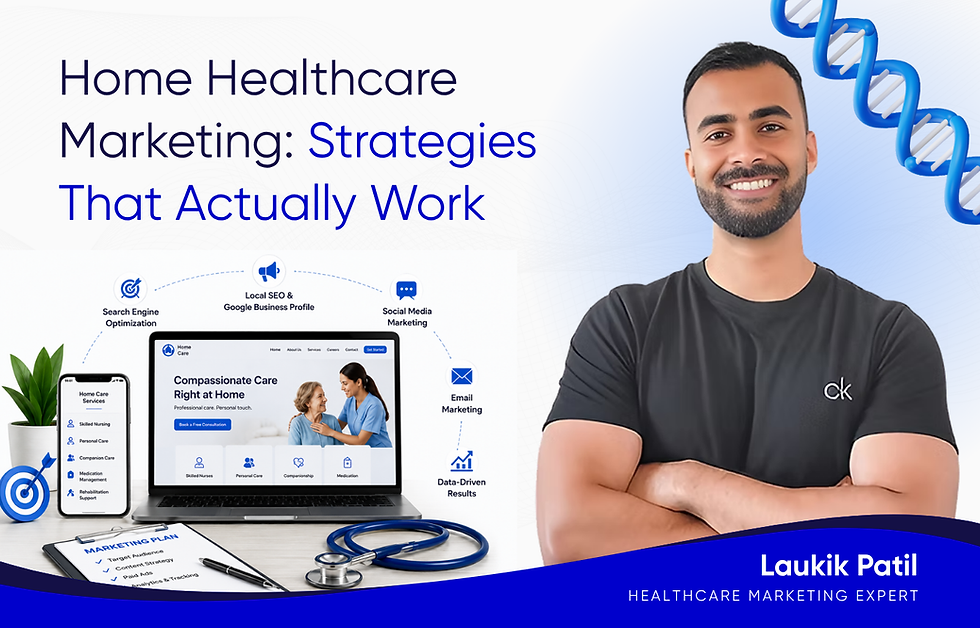
Home healthcare marketing is the process of helping a home health or home care agency become visible when families and referral sources are looking for care, earn trust before the first conversation, and turn that attention into qualified inquiries and booked consultations. The strongest approach combines local SEO, healthcare content, reputation management, referral relationships, paid advertising, website conversion, and consistent follow-up. For agencies competing in crowded local markets, the goal isn't simply more traffic or leads. It's a marketing system that connects visibility to real patient or client acquisition.
LxP Digital client data shows how much a connected patient acquisition system can influence healthcare growth: one healthcare client increased patient bookings by 127% in 90 days. Results vary by clinic and campaign. |
Here's why it matters right now: somewhere in your city, an adult daughter is Googling "home health care near me" at 11 p.m., trying to find someone she can trust with her dad's care. She'll decide whether to call you within seconds of seeing your website, reviews, services, and contact options. You can run the best agency in your county and still lose to a competitor with stronger online visibility, clearer messaging, faster follow-up, or better reviews.
Want to grow your healthcare business? We can help.
What Is Home Healthcare Marketing?
Home healthcare marketing brings together the strategies that help a home health or home care provider get found, build credibility, and turn interested prospects into inquiries and clients. That can include local SEO, healthcare content, Google Ads, reputation management, social media, referral marketing, website optimization, and follow-up.
The tricky part: you're marketing to two audiences at once. Families want warmth and trust from the caregiver who'll be in their loved one's home. Referral sources want reliability and professionalism. Your marketing needs to communicate both without making the agency sound clinical in one place and overly promotional in another.
There is also an important distinction between home health and home care. Home health generally involves skilled healthcare services delivered in the home, while home care commonly refers to non-medical support such as personal care, companionship, or help with daily activities. The exact services and terminology vary by provider, payer, and location. Your marketing should make it immediately clear what your agency actually provides.
Why Does Home Healthcare Marketing Matter More in 2026?
Families increasingly research healthcare providers before making contact. That makes online visibility and trust part of the decision-making process, not simply an extra layer of promotion. The Federal Reserve Bank of San Francisco reported that U.S. home-care revenue grew from $78.5 billion in 2011 to $109.6 billion in 2021, highlighting the scale and continued expansion of the industry.
The tradeoff: more competitors are chasing that same demand. CMS's Medicare Care Compare tool publishes quality information for home health agencies and allows patients and caregivers to compare agencies based on publicly reported performance data. The CMS data currently covers more than 12,000 home health agencies. That means families have more information available when evaluating providers. If your agency isn't visible when they start comparing their options, you may never make the shortlist.
Looking to grow your practice? Let's make it happen.
What Are the Best Home Healthcare Marketing Strategies?
The most effective home healthcare marketing strategies work together rather than operating as isolated channels. They include local SEO, a conversion-focused website, educational content, review management, compliant referral relationships, paid search, social media, and video or email nurture.
Local SEO and Google Business Profile: Most inquiries start here. Update your Google Business Profile monthly with new photos and services, keep your name, address, and phone number consistent everywhere online, and target searches like "in-home nursing care in [city]." A solid healthcare SEO foundation is what makes every other strategy on this list actually get seen.
Getting stuck here is normal. GBP suspensions, category mix-ups, and inconsistent listings trip up most agencies trying to DIY this. See how our healthcare SEO team handles it so you can focus on running your agency.
A website that builds trust in seconds: Your website is a digital front door. Fast load times, clear calls to action, and real testimonials do more for patient acquisition than any clever tagline. A slow or vague homepage loses families before they read your mission statement.
Content that answers real questions: Skip the generic "About Our Services" page. Write the article that answers what a caregiver is actually Googling at 2 a.m., "how to talk to a parent about needing help" or "home health vs. hospice, what's the difference." This kind of content builds trust before the first phone call.
Online reviews and reputation management: Families trust other families more than they trust your marketing. Ask for reviews after the first few weeks of care, respond to every one, and never leave a negative review unanswered. Beyond Google reviews, agencies also build credibility on caregiving-specific platforms like Caring.com and SeniorAdvisor.com, where families actively compare providers.
Referral partnerships, with a compliance filter: Hospitals, discharge planners, and physicians remain the highest-value referral source. Federal rules, the Anti-Kickback Statute, and physician self-referral law mean you can't pay, gift, or incentivize your way into referrals. What works instead: responsiveness, education, and consistently making a referring doctor's job easier. If a referral arrangement feels like it might cross a line, that's a question for healthcare counsel, not a marketing team.
Paid search ads for high-intent searches: While organic SEO builds, Google Ads puts you in front of families searching right now for terms like "24-hour home care" or "Medicare-certified home health." Pair this with retargeting so visitors who didn't call see your ad again days later.
A word of caution before you launch a campaign yourself: Healthcare ad accounts get flagged and disapproved constantly over compliance issues most agencies don't see coming. Talk to our Google Ads for Healthcare team before you spend your first dollar.
Social media for familiarity: Nobody hires a caregiver off a Facebook post, but consistent activity, caregiver spotlights, safety tips, and client stories build the familiarity that makes someone comfortable calling you when the need becomes urgent.
Video and email as long-cycle nurture: A 60-second video explaining what a first visit looks like calms nervous families more than a page of text. Email keeps you top of mind with families who aren't ready yet, because in home care marketing, "not ready" often becomes "ready" within weeks.
Home Healthcare Marketing Strategies: Cost and Timeline at a Glance
Typical cost and time-to-results vary by strategy; here's a general benchmark for planning purposes. The following benchmarks are useful for planning, but they should not be treated as guaranteed outcomes. A 2026 benchmark for independent home health and hospice agencies estimates that Google Ads can generate leads immediately, while SEO and content marketing generally require several months to build meaningful traction.
Strategy | Typical Monthly Cost | Time to See Results |
Local SEO / Google Business Profile | 500–1,500 | 3–6 months |
Website optimization | One-time 3,000–10,000+ | Immediate to 1 month |
Content marketing | 800–2,500 | 4–8 months |
Review management | 200–600 | 1–3 months |
Referral partnership building | Staff time, minimal ad spend | 2–6 months |
Paid search (Google Ads) | 1,000–5,000+ ad spend | Days to weeks |
Social media management | 500–1,500 | 3–6 months |
Want to grow your clinic faster? Let's talk today
Does Home Healthcare Marketing Look the Same for Every Agency?
No, the right strategy depends on agency size. A ten-client startup and a forty-location regional group shouldn't run the same playbook:
Startups: Prioritize Google Business Profile, a clean website, and asking every happy family for a review.
Scaling agencies: Add referral systems and paid ads as budget allows.
Multi-location groups: Standardize local SEO and brand consistency across every market served.
Not sure which stage you're really in? Most agency owners are too close to their own business to see it objectively. Get a free marketing assessment, and we'll tell you honestly which strategy deserves your next dollar.
How Do You Measure Home Healthcare Marketing ROI?
Track lead source, cost per lead, and follow-up speed for every new inquiry, not just website traffic. Ask every new client "How did you hear about us?" and record the answer. Home health has a longer, messier sales cycle than most local businesses, often involving multiple decision-makers. Without source tracking, you're guessing where next month's budget should go.
Frequently Asked Questions
How much should a home health agency spend on marketing?
Most growing agencies reinvest somewhere between 5–10% of revenue into marketing, weighted toward SEO and reviews early on, with paid ads added as they scale.
What's the fastest way to get more referrals?
Consistent follow-up and responsiveness with existing referral sources usually beats chasing new ones. Doctors and discharge planners refer to whoever makes their job easiest.
Is paid advertising worth it for a small agency?
Yes, in small, targeted doses, a modest local Google Ads campaign around high-intent keywords can generate calls while organic SEO is still building.
Can I offer incentives to referral sources?
Be careful here. Anything that transfers value, payments, gifts, or staffing help for referrals can violate federal healthcare law. Stick to education and relationship-building, and consult healthcare counsel before trying anything creative.
How long until home healthcare SEO shows results?
Usually three to six months for meaningful movement, longer in competitive metro areas. It's a compounding effort, not a light switch.
Your Next Step
None of this requires a massive budget or an in-house marketing department. It requires picking the two or three home healthcare marketing strategies that fit where your agency is right now and sticking with them.
If you'd rather have a team that already knows the compliance lines, the local SEO playbook, and what actually converts families in this industry, that's exactly what we do at LxP Digital. Get a free marketing assessment and let's figure out where your next client is actually going to come from.

Laukik Patil
Healthcare Digital Marketing Strategist
A results-driven healthcare digital marketing strategist helping clinics and healthcare brands grow their online presence. He specializes in SEO, local search optimization, content strategy, and data-driven marketing to increase visibility, attract qualified leads, and support sustainable business growth.


